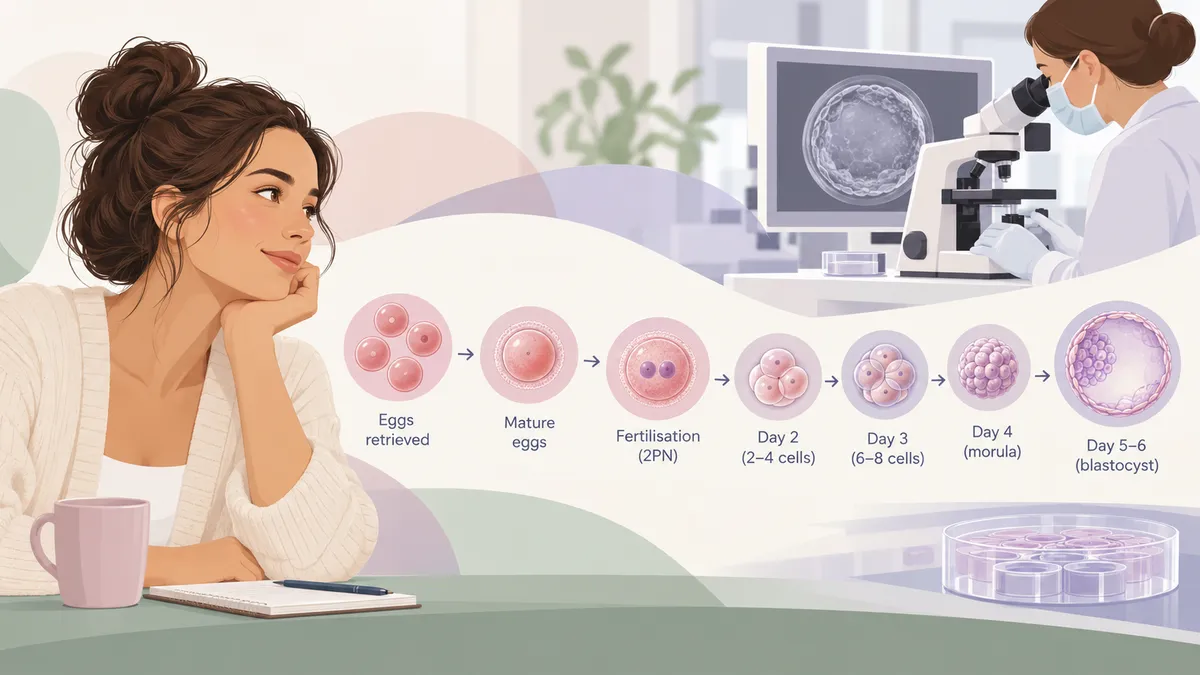
What Happens After Egg Retrieval? Eggs to Embryos Explained
What Happens After Egg Retrieval? Eggs, Maturity, Fertilisation & Embryo Development
Egg collection gives you one number. Then come mature eggs, fertilisation, embryos and blastocysts. Here’s what actually happens in the IVF lab after egg retrieval — and what those changing numbers really mean.
Egg collection is over.
You wake up and somebody tells you:
“We collected 10 eggs.”
And for a moment, 10 becomes the number.
Then IVF does what IVF does.
Ten eggs becomes eight mature eggs.
Eight becomes six fertilised.
Six becomes four developing embryos.
Perhaps two reach blastocyst.
And suddenly you're wondering:
Where did the others go?
Was something wrong with the eggs?
Was it the sperm?
Did the trigger not work properly?
Does this mean the IVF cycle is failing?
And perhaps the hardest question:
How many of these embryos might actually give us a baby?
This is the part of IVF that can feel especially brutal because, after weeks of actively injecting, scanning, eating, researching and preparing, much of what happens next takes place inside a laboratory where you cannot influence it.
So let's make those numbers considerably less mysterious.
If you're still approaching retrieval rather than recovering from it, start with Preparing for Egg Retrieval: What to Do Before IVF Egg Collection →
Quick answer: what happens after egg retrieval?
Once the eggs are collected, they are passed to the embryology laboratory.
From there, several distinct things need to happen.
Eggs retrieved → mature eggs → normally fertilised eggs → developing embryos → blastocysts → embryos suitable for transfer or freezing
Those numbers are not expected to remain identical all the way through.
Not every follicle contains an egg.
Not every retrieved egg will necessarily be mature.
Not every suitable egg will fertilise normally.
Not every fertilised egg will continue developing.
And not every developing embryo will reach the stage your clinic considers suitable for transfer or freezing.
That is not automatically evidence that somebody has done something wrong.
It is biology being revealed one stage at a time.
NHS fertility information describes the same progression: eggs are fertilised after collection, checked the following day and then cultured for several days while embryologists monitor development. nhs.uk
The first number: how many eggs were actually retrieved?
During egg collection, follicular fluid is removed from the follicles and examined for eggs.
This is why:
number of follicles ≠ number of eggs retrieved.
A follicle is the fluid-filled structure in the ovary in which an egg may be developing.
It isn't itself an egg.
And not every follicle will yield one.
Guy's and St Thomas' NHS Foundation Trust specifically explains that not every follicle contains an egg and that sometimes fewer eggs are collected than the number of follicles seen on ultrasound might have suggested. Guy's NHS Trust
So if your final scan showed 14 follicles and the embryologist tells you 10 eggs were collected, that doesn't automatically mean four eggs were somehow “lost”.
The ultrasound and the laboratory are measuring different things.
Then comes egg maturity
This is where the next number can change.
Egg retrieval tells you how many eggs were found.
It does not automatically tell you that every one of those eggs had completed the maturation needed for fertilisation.
You may hear the embryology team use terms such as:
MII — metaphase II: a mature egg.
MI — metaphase I: an egg that has not yet reached the mature MII stage.
GV — germinal vesicle: an earlier stage of egg maturation.
You don't need to become an embryologist.
Just remember:
retrieved does not necessarily mean mature.
This is particularly obvious during ICSI, because the cells surrounding the egg are removed and the embryologist assesses maturity before injection. Cambridge IVF notes that ICSI can only be performed on mature eggs and that having some immature eggs after collection is not unusual. cambridge-ivf.nhs.uk
So is it bad if some of my eggs are immature?
Not automatically.
A proportion of immature eggs can occur in IVF.
What becomes more interesting clinically is the pattern.
For example, if an unexpectedly large proportion of retrieved eggs are immature — particularly if this has happened repeatedly — that may be information your treating team considers alongside:
your stimulation response,
follicle sizes,
trigger medication,
trigger timing,
and what happened in previous cycles.
It still doesn't allow somebody looking at one number online to tell you the cause.
Context matters.
If you're trying to understand the trigger stage immediately before collection, read:
IVF Trigger Shot Before Egg Retrieval: Timing, Types & What Happens Next →
What happens to the eggs on egg-retrieval day?
The exact laboratory process depends partly on whether you are having conventional IVF or ICSI.
With conventional IVF
Prepared sperm and eggs are placed together in laboratory conditions so that fertilisation can occur.
With ICSI
ICSI stands for intracytoplasmic sperm injection.
A single sperm is injected directly into a mature egg.
ICSI is commonly used in situations involving sperm-related fertility problems and in some other clinical circumstances. The NHS describes conventional IVF and ICSI as different ways of achieving fertilisation, with ICSI involving injection of an individual sperm directly into an egg. Guy's NHS Trust
And this is worth understanding:
ICSI helps sperm enter the egg.
It does not guarantee fertilisation.
And it doesn't bypass everything that has to happen biologically afterwards.
Day 1 after egg retrieval: the fertilisation call
For many people, this is the first deeply nerve-racking phone call.
Usually the day after egg collection, the embryology team checks which eggs have fertilised.
One recognised sign of normal fertilisation is the presence of two pronuclei — often written as 2PN.
One represents genetic material from the egg and one from the sperm before they combine further.
HFEA and NHS embryology information describes two pronuclei as the expected appearance following normal fertilisation. HFEA
So you might hear:
“Eight eggs were suitable and six fertilised normally.”
That doesn't mean two embryos somehow “died overnight”.
It means you're now measuring a different biological stage.
And that distinction matters throughout the next several days.
Why don't all mature eggs fertilise?
Because fertilisation itself is biologically complicated.
An egg being mature enough for fertilisation doesn't guarantee that normal fertilisation will occur.
Neither does placing sperm beside it.
And neither does injecting one sperm directly into it with ICSI.
Egg factors may matter.
Sperm factors may matter.
The interaction between egg and sperm may matter.
Laboratory factors and individual biology can also matter.
This is exactly why one unexpectedly poor fertilisation result should be reviewed rather than converted into a simplistic diagnosis from Google.
If sperm health or male factor is already part of your fertility picture, this is worth reading:
How to Improve Sperm Health: What Actually Helps Male Fertility? →
Does poor fertilisation mean the sperm was the problem?
Not necessarily.
This is one of the easiest conclusions to jump to:
“The eggs were collected, so if they didn't fertilise it must be the sperm.”
But fertilisation depends on both gametes and the biological processes that occur between them.
A poor fertilisation result may lead a fertility team to consider sperm factors.
It may also lead them to consider egg-related factors, the fertilisation method, what happened during that specific cycle or whether anything should be handled differently next time.
That is why:
poor fertilisation is information.
It isn't automatically a diagnosis.
The same principle applies throughout embryo development.
IVF numbers are a funnel — not because IVF is failing, but because every stage asks a different biological question
This is probably the single most useful thing to understand after egg collection.
The numbers answer different questions.
Stage | What the number tells you |
|---|---|
Follicles | What structures were seen developing in the ovaries |
Eggs retrieved | How many eggs were actually found at collection |
Mature eggs | How many had reached the appropriate stage of maturation |
Normally fertilised | How many showed evidence of normal fertilisation |
Developing embryos | How many continued dividing after fertilisation |
Blastocysts | How many reached the later preimplantation developmental stage |
Transfer/freezing | Which embryos were considered appropriate for the planned next step |
This is why I don't like the phrase:
“We started with 12 and only ended with two.”
I completely understand emotionally why it feels like that.
But biologically, those were never twelve confirmed transferable embryos.
You started with twelve retrieved eggs.
Then every subsequent stage told you something new.
That doesn't make falling numbers painless.
It makes them interpretable.
What happens on Day 2 and Day 3 after egg retrieval?
Once normal fertilisation has occurred, the embryo begins dividing.
NHS guidance describes embryos commonly reaching around 2–4 cells by Day 2 and approximately 6–8 cells by Day 3, although real embryos do not all develop according to an identical clock. Guy's NHS Trust
By this point, embryologists are looking at more than whether an embryo simply exists.
They may assess things such as:
the number of cells,
the appearance and symmetry of those cells,
fragmentation,
and the overall developmental pattern.
Your clinic may give you an update on Day 3.
Other clinics minimise interruptions to culture or use different update schedules.
So don't assume that someone else's daily phone calls represent what your clinic should be doing.
Day 4: the morula stage
Around Day 4, cells can begin to compact tightly together.
This stage is known as the morula.
It is part of the transition between the earlier cleavage-stage embryo and the blastocyst that may form during the following days.
Newcastle Hospitals' IVF guidance describes this compaction occurring around Days 4–5 before the embryo expands into the blastocyst stage. Newcastle Hospitals NHS Foundation Trust
Most patients don't hear much about the morula.
And that's fine.
You don't need to memorise every microscopic developmental milestone to understand your IVF.
Day 5 and Day 6: the blastocyst stage
By around Day 5 or Day 6, some developing embryos reach the blastocyst stage.
A blastocyst has developed far beyond the handful of cells present earlier in culture and has begun forming distinct structures.
This is commonly the stage at which embryos may be:
transferred,
frozen,
or — if already clinically planned — biopsied for particular forms of preimplantation genetic testing.
NHS fertility services describe embryos reaching the blastocyst stage around Day 5–6, although not every embryo will reach that point on precisely the same day. Newcastle Hospitals NHS Foundation Trust
Is a Day 6 blastocyst bad?
Not simply because it reached blastocyst on Day 6 rather than Day 5.
Embryos develop at different rates.
The significance of an individual embryo's development, grading and suitability for transfer or freezing needs to be interpreted by your embryology team rather than from one characteristic alone.
The important point here is that Day 5 isn't a finish-line deadline after which every embryo still developing has automatically failed.
Your laboratory may continue observing appropriate embryos into Day 6 and sometimes according to its own protocols beyond that.
Why do some embryos stop developing?
Because creating a viable embryo requires an extraordinary amount of biology to work correctly.
Not every fertilised egg has the developmental capacity to continue through every stage.
Chromosomal abnormalities can be one reason embryos stop developing.
But development can also reflect numerous aspects of egg biology, sperm biology and embryo biology that cannot be diagnosed merely by watching where an embryo stopped.
This is another place where the internet tends to leap too quickly from:
“my embryos stopped developing”
to:
“therefore I have X problem.”
Sometimes a developmental pattern does give your fertility team something worth investigating or discussing.
But:
a pattern can be a clue without being proof of its cause.
That's an important Fertility Bandwidth distinction.
What does embryo grading mean?
Once embryos are developing, clinics may give them grades based mainly on how they look at particular stages.
The exact grading system varies.
At the blastocyst stage, you may hear combinations of numbers and letters such as:
4AA, 3AB or 5BB.
These describe aspects of the blastocyst's development and appearance.
They are useful to embryologists when assessing and prioritising embryos.
But an embryo grade is not the same thing as a guarantee of implantation, pregnancy or a chromosomally normal embryo.
Appearance gives information.
It does not reveal everything about an embryo.
That is why it is possible for an attractive-looking embryo not to result in pregnancy — and for embryos with less impressive morphology to result in healthy births.
Don't turn the letters on your embryo report into a verdict on your future.
Does embryo grading tell you whether an embryo is chromosomally normal?
No.
Morphological grading and chromosome testing are different things.
An embryologist grades an embryo largely according to developmental appearance.
PGT-A, where used, involves testing cells from an embryo for chromosome-number abnormalities.
And it is important not to turn PGT-A into another automatic “more testing must be better” assumption.
The HFEA currently rates PGT-A red for increasing the chance of having a baby for most fertility patients, while rating it green for reducing miscarriage risk for most patients; whether it is appropriate needs individual clinical discussion. HFEA
That deserves a separate conversation with your clinic, rather than being treated as the inevitable next step after creating blastocysts.
Why did we get fewer blastocysts than we expected?
Because fertilisation and blastocyst development are two different hurdles.
A normally fertilised egg still has several days of complex cell division and development ahead of it.
So:
10 eggs retrieved
does not mean
10 embryos
and 10 embryos on Day 1 does not mean
10 blastocysts.
It is tempting to search for a universal chart telling you how many you should have at each stage.
I would be cautious with that.
Average attrition statistics describe groups.
They don't tell you what should happen in your particular cycle.
Age, eggs, sperm, treatment history and individual biology all affect the context.
Your own results become much more useful when compared with what actually happened throughout your cycle than when compared with a stranger's fertility funnel online.
Is one blastocyst enough?
One blastocyst is one blastocyst.
It is not zero.
And it is not ten.
But the number alone cannot tell you whether it will result in a baby.
That depends on characteristics of the embryo, the person undergoing transfer, treatment circumstances and biology that we cannot completely predict.
So I wouldn't tell somebody with one embryo:
“One is all you need.”
because although it sounds comforting, it can imply an outcome nobody can promise.
And I wouldn't tell them:
“You only got one.”
because that turns a viable next opportunity into failure before it has even been used.
What's important to remember is:
you have one embryo available for the next stage, and its outcome isn't known yet.
What happens if none of the embryos reach blastocyst?
That is devastating.
And it also leaves information worth reviewing.
Your clinic may look back across the entire treatment cycle:
how the follicles developed,
how many eggs were retrieved,
egg maturity,
fertilisation,
whether IVF or ICSI was used,
when embryo development changed,
sperm information,
and what happened in previous cycles.
But this is exactly where I would resist immediately buying every supplement, test and IVF add-on you find.
The question should be:
What does this particular result give us a reason to investigate or discuss?
not:
What can I possibly add before we try again?
If an IVF cycle hasn't gone as hoped, read:
Failed IVF: What Should You Do Before Trying Again? →
What happens to blastocysts after they develop?
This depends on your treatment plan.
An embryo may be used for a fresh embryo transfer during the same treatment cycle.
Suitable embryos may instead be frozen for later use.
And in some cycles, all suitable embryos are frozen rather than carrying out a fresh transfer.
The HFEA explains that embryos can be frozen at different stages, although blastocyst-stage freezing is now common, usually using rapid freezing called vitrification. HFEA
If you're moving towards a transfer, the next part of our IVF pathway is:
What to Do Before Embryo Transfer: What Actually Matters →
And if your embryos have been frozen and you're preparing for a later frozen transfer:
Preparing for Frozen Embryo Transfer →
What should you expect physically after egg retrieval?
While all of this is happening in the laboratory, your body is recovering too.
Some lower abdominal or pelvic discomfort and light blood-stained discharge can occur after egg collection. Your own clinic's medication, progesterone, activity and recovery instructions take priority. Guy's NHS Trust
But don't assume worsening symptoms are simply the price of IVF.
OHSS — ovarian hyperstimulation syndrome — can occur after fertility treatment and can become serious.
Contact your fertility unit if you are concerned, particularly if you develop worsening abdominal swelling or pain, vomiting, reduced urination, chest pain or difficulty breathing. RCOG advises contacting the fertility team when OHSS symptoms develop or worsen. rcog.org.uk
And then comes one of the hardest parts: waiting
By now you've probably noticed something.
During stimulation, you could do things.
Take the injections.
Attend the scans.
Take the trigger.
Turn up for collection.
After retrieval, control suddenly collapses.
The embryos are in the laboratory.
You cannot eat the right food today to make a Day 3 embryo become a blastocyst tomorrow.
You cannot think positively enough.
You cannot undo a fertilisation result.
You cannot make one embryo divide by worrying about it harder.
And that loss of control can feel horrendous.
Understanding what the numbers mean isn't about becoming detached from them.
It's about removing some of the unnecessary responsibility.
Read: https://fertilitybandwidth.com/post/increase-implantation-success-naturally
Your IVF results are information — not a judgement on how well you prepared
This is the thread I want to keep running through all of these IVF pages.
If 12 follicles became 9 eggs, 7 mature eggs, 5 fertilised embryos and 2 blastocysts, you do not need to turn every reduction into:
“What did I do wrong?”
These numbers can provide useful clinical information.
Sometimes a particular stage deserves closer attention.
Sometimes a pattern across more than one cycle becomes important.
Sometimes your fertility team may recommend doing something differently.
And sometimes biology doesn't give you a neat explanation.
That uncertainty is difficult.
But inventing certainty isn't better.
IVF isn't one result
We often talk about an IVF cycle as if it has only two possible outcomes:
worked
or
failed.
Biologically, far more happened.
You learned how your ovaries responded to stimulation.
How follicles developed.
How many eggs were retrieved.
How many were mature.
How fertilisation went.
How embryos developed.
Whether they reached blastocyst.
And perhaps how an embryo behaved after transfer.
None of those stages automatically diagnoses the reason you needed IVF.
But together, particularly after a previous cycle, they can provide information worth understanding.
That is one reason I don't believe good IVF preparation means blindly doing more.
It means understanding the fertility picture you are actually bringing into treatment.
Want to understand what deserves your attention before or during IVF?
IVF Prep by Fertility Bandwidth™ is designed to help you make sense of the different areas surrounding fertility treatment without turning IVF into another full-time job.
It isn't a replacement for your fertility clinic.
And it doesn't promise to control outcomes nobody can guarantee.
It helps you understand:
what may deserve attention,
what your existing results might be telling you,
what belongs with your clinic,
and what you can stop carrying around as another thing you're supposed to fix.
FAQs
How soon after egg retrieval do you find out how many eggs fertilised?
Clinics commonly check for fertilisation the following day and contact you with an update. Exact communication schedules vary between clinics. Guy's NHS Trust
How many eggs should be mature after egg retrieval?
There is no single number or percentage that every IVF cycle should produce. Some retrieved eggs may be immature, and the significance depends on the number retrieved, your treatment response and the wider circumstances of the cycle. During ICSI, only mature eggs can be injected. cambridge-ivf.nhs.uk
How many eggs should fertilise after IVF or ICSI?
Not every suitable egg will fertilise normally. Fertilisation rates vary between patients and cycles, so a population average should not be treated as a prediction of your individual result. Your embryologist can explain your own fertilisation result in the context of your egg and sperm information.
What does 2PN mean in IVF?
2PN means two pronuclei. It is the classic laboratory sign of normal fertilisation, representing the maternal and paternal genetic material before these combine further during embryo development. HFEA
When does an embryo become a blastocyst?
Embryos commonly reach the blastocyst stage around Day 5 or Day 6 after egg collection/fertilisation, although development varies between embryos. Newcastle Hospitals NHS Foundation Trust
Is it normal for embryo numbers to drop after egg retrieval?
Yes. Eggs retrieved, mature eggs, normally fertilised eggs, developing embryos and blastocysts are different biological stages. The numbers therefore do not normally remain identical throughout the IVF laboratory process.
What happens after a Day 5 blastocyst develops?
Depending on your treatment plan and the embryo, it may be transferred during a fresh cycle, frozen for future transfer or handled according to previously agreed testing plans. Your embryology team will tell you what applies to your embryos.
Is a blastocyst grade the same as chromosome testing?
No. Embryo grading assesses aspects of development and appearance. Genetic testing such as PGT-A examines sampled embryo cells for chromosome-number abnormalities. They provide different information.
Can anything I do after egg retrieval improve embryo development?
Once the eggs have been collected and are developing in the laboratory, you cannot alter those embryos through a particular food, supplement, exercise routine or mindset over the following few days. Follow your clinic's recovery and medication instructions and allow the embryology team to do its work.
Evidence and further reading
Guy's and St Thomas' NHS Foundation Trust — Fertilisation and embryo developmentIVF fertilisation guidance
Cambridge IVF — What happens in the embryology laboratoryCambridge IVF embryology guidance
HFEA — Embryo freezingHFEA embryo freezing guidance
RCOG — Ovarian hyperstimulation syndromeRCOG OHSS guidance
