
What Happens to Your Body When You Get Pregnant Naturally
You got a positive test. And now, somewhere between the disbelief and the quiet wonder, you might be thinking: what on earth is actually happening inside me right now?
So let's talk about what's really going on. Because when your body is pregnant, the changes are nothing short of extraordinary. We're talking about a complete physiological overhaul, one that starts within days of conception and doesn't fully reverse until well after your baby is born.
Before we get into the science, let’s pause for a second.
If you got pregnant naturally, especially if you've been trying for a while, or if you're in your 30s or 40s and were told it might be difficult, this is genuinely remarkable. Your body did something complex, precise, and frankly a little miraculous.
That's worth acknowledging.
What Triggers All These Changes?
Hormones are the “commanders-in-chief” of your body. They dictate how you feel throughout your pregnancy.
Some days, they make you feel better and happier. Other days, they make things a little uneasy. It all depends on which particular hormone is the “Sheriff” on duty that particular period.
Here are some of the hormones that cause changes during pregnancy:
hCG (human chorionic gonadotrophin): This is the hormone your pregnancy test detects. It's produced by the cells that will eventually become your placenta, and it surges rapidly in early pregnancy, doubling roughly every 48 to 72 hours. It's also the main hormone behind morning sickness.
Progesterone: Produced first by your ovary, then increasingly by the placenta, progesterone is the hormone that maintains your pregnancy, prevents premature contractions, and relaxes smooth muscle throughout your body. This relaxation is responsible for quite a few of the less glamorous symptoms: heartburn, constipation, and breathlessness.
Oestrogen: Works alongside progesterone to support your growing pregnancy. It helps in blood vessel growth and triggers many of the physical changes to your skin, hair, and breasts.
Relaxin: A hormone that softens and loosens ligaments and connective tissue throughout your body in preparation for birth. It starts working early, which is why some women notice joint discomfort or increased mobility even in the first trimester.
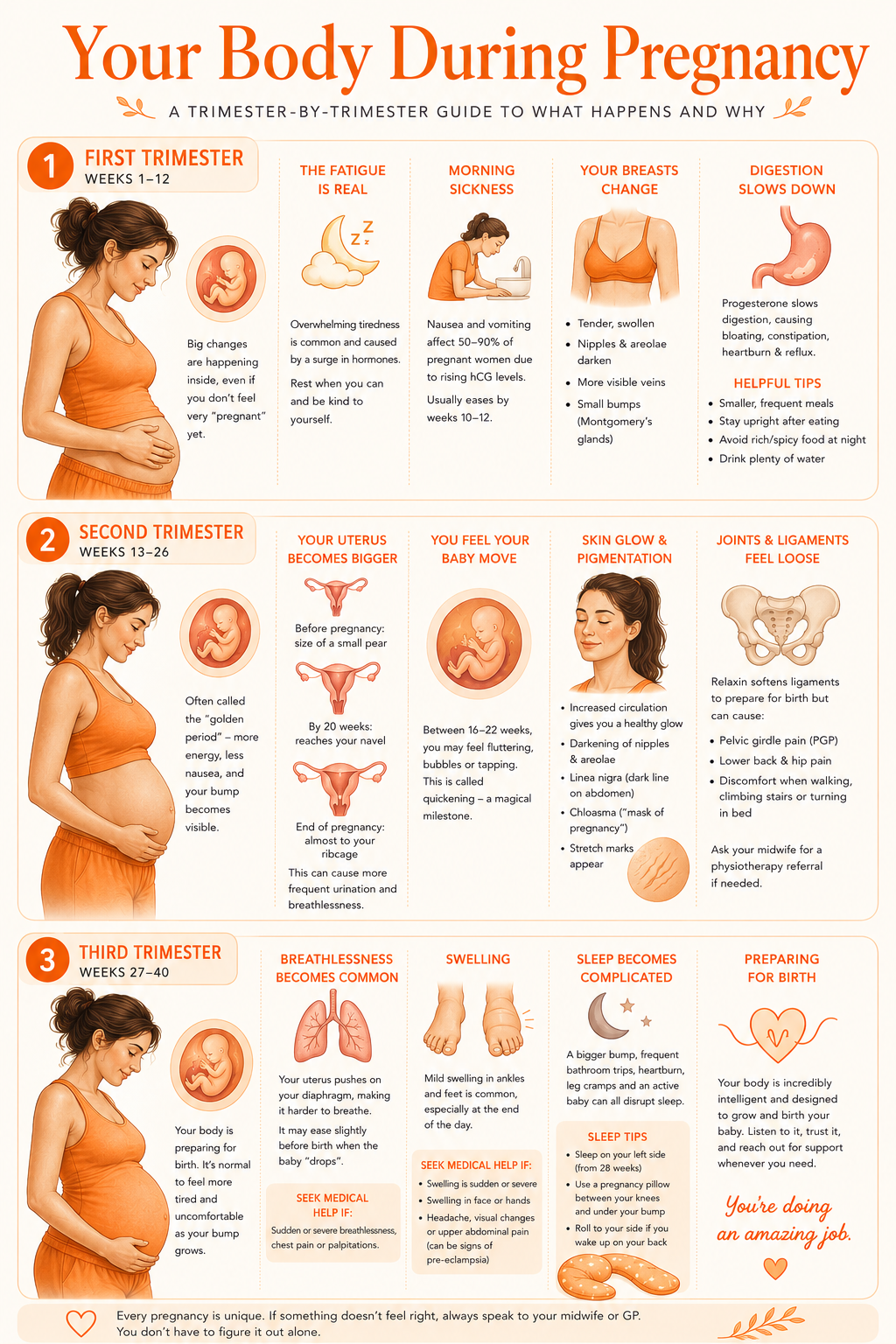
Your Body in the First Trimester (Weeks 1–12)
The fatigue is real
The exhaustion of the first trimester is genuinely difficult to describe until you've experienced it. This isn't normal tiredness. This is the kind of fatigue where you might fall asleep at your desk at 2pm despite a full night's sleep.
Be kind to yourself about this. It is not laziness. It is biology.
Morning sickness
Nausea and vomiting in pregnancy, which affects somewhere between 50 and 90% of pregnant women, is closely linked to the surge of hCG in the first trimester. hCG levels peak around weeks 8 to 10, almost exactly the same time when nausea tends to be at its worst. As the placenta takes over hormone production (around weeks 10 to 12), hCG levels stabilise, and most women find the nausea begins to ease.
If it becomes unmanageable and progresses to hyperemesis gravidarum, a severe, persistent vomiting that can cause weight loss and dehydration, please speak to your GP.
Your breasts change
For many women, tender, swollen breasts are the very first sign that something has changed, sometimes even before a missed period. This is oestrogen and progesterone, preparing your breast tissue to produce milk. You might notice:
Increased fullness and sensitivity
Darkening of the nipples and areolae (this is permanent in some women)
Visible veins beneath the skin
Small bumps appearing around the nipples (Montgomery's glands, these produce a lubricating secretion that will help with breastfeeding)
The digestive system slows right down
Progesterone relaxes smooth muscle, and most of your entire digestive tract is made of smooth muscle.
The result?
Everything moves more slowly through it.
Food takes longer to leave your stomach (causing heartburn and acid reflux), moves more slowly through your intestines (causing bloating, gas, and constipation), and the valve between your stomach and oesophagus becomes more relaxed (allowing stomach acid to creep upward, especially when you lie down).
Here are practical strategies that help.
Smaller, more frequent meals; staying upright for at least 30 minutes after eating; avoiding rich or spicy food at night; and drinking plenty of water to help with constipation.
Your Body in the Second Trimester (Weeks 13–26)
The second trimester is your "golden period", and for many women, it genuinely is. The fatigue and nausea typically ease, and the bump becomes visible enough to feel exciting without yet being uncomfortable.
Your uterus becomes bigger
Before pregnancy, your uterus is roughly the size of a small pear. By 20 weeks, the top of it reaches your navel. By the end of pregnancy, it extends almost to your ribcage, pushing your stomach, liver, bladder, and diaphragm as it goes.
This explains a lot of third-trimester symptoms that actually begin in the second: you need to urinate more frequently because your bladder has less space; and breathlessness can develop because your diaphragm has less room to move.
You feel your baby move
Somewhere between 16 and 22 weeks (usually earlier for women who've been pregnant before), you'll begin to feel the baby move. Initially it might feel like fluttering, bubbles, or faint tapping. This is called quickening, and it's one of the most emotionally significant moments in many pregnancies.
Skin glow
The so-called "pregnancy glow" is real, increased blood circulation brings more blood to the skin's surface, giving a flushed, radiant appearance.
Hyperpigmentation, darkening of the skin, is also common. This can affect:
The nipples and areolae (which often remain darker after pregnancy)
The linea nigra, a dark vertical line running down the centre of the abdomen (it was always there; pregnancy hormones just make it visible)
The face, a condition called chloasma or "the mask of pregnancy," which causes patchy darkening across the cheeks, nose, and forehead, particularly with sun exposure
You may also develop stretch marks as your tummy grows bigger.
Your joints and ligaments feel lose
The hormone relaxin, works throughout pregnancy to soften the ligaments and cartilage around your pelvis. It's your body’s way of making birth flexible.
The downside is that this affects all your joints, not just the pelvis.
Many women experience pelvic girdle pain (PGP), sometimes called symphysis pubis dysfunction (SPD), which can cause pain in the front of the pelvis, the lower back, and the hips, especially when climbing stairs, turning over in bed, or walking for long periods.
If this is you, ask your midwife for a referral to a physiotherapist who specialises in pregnancy.
Your Body in the Third Trimester (Weeks 27–40)
The third trimester is when the physical demands of pregnancy become most visible, and most felt. Your body is gradually rounding up and getting ready to deliver your baby .
Breathlessness becomes common
As your uterus rises into your abdomen, it pushes against your diaphragm, which has significantly less room to move. This is why many women feel breathless when talking, going upstairs, or even lying down. It often improves slightly a few weeks before birth, when the baby's head drops into the pelvis, a process called engagement or "lightening."
However, a sudden or severe breathlessness, or breathlessness accompanied by chest pain or palpitations, always requires immediate medical attention.
Swelling
Ankle and foot swelling is one thing almost all women experience in late pregnancy. Your increased blood volume, the pressure of the uterus on major blood vessels, and the effect of gravity all combine to cause fluid to pool in the lower limbs, particularly by the end of the day or after standing for long periods.
Mild, symmetrical swelling of the ankles and feet is normal. However, sudden or rapid swelling, particularly of the face and hands, or swelling that's accompanied by headache, visual disturbances, or upper abdominal pain, can be a sign of pre-eclampsia and requires urgent assessment.
Your sleep becomes complicated
Sleeping comfortably in the third trimester is quite a challenge. The combination of a large bump making lying flat difficult, frequent trips to the loo, heartburn, leg cramps, and an active baby can make good sleep feel impossible.
You're advised to sleep on your side, ideally the left side, from around 28 weeks. Experts suggest that sleeping on your back in late pregnancy can restrict blood flow through the inferior vena cava (the major vein running behind the uterus), which may reduce the blood supply to the baby. If you wake up on your back, simply roll to your side, you haven't done any harm.
A pregnancy pillow between your knees and under your bump can make a significant difference to comfort.
If you're actively thinking of what a normal pregnancy looks like and you want to get pregnant naturally, you can start with our Fertility Reset Programmes here.
Your Final Expert Advice
When you understand your body during pregnancy, it isn't just intellectually interesting. It's genuinely empowering. When you know why you feel the way you feel, it becomes easier to tell what's normal from what needs attention. It becomes easier to say what truly matters for yourself in medical appointments. And it becomes easier to trust your body, which is, right now, doing something extraordinary on your behalf.
A normal pregnancy involves hundreds of physiological changes across every system in your body. Most of them are purposeful. Most of them are manageable. And all of them are temporary, even when they don't feel like it at the moment.
You're not just growing a baby. You're being rebuilt.
And we're here to help you understand every step of it.
Want to learn more? Visit: https://fertilitybandwidth.com/fertilityresetprogrammes
Karen Botha
Karen Botha is a Root Cause Fertility Practitioner who helps couples find the hidden health issues that may be affecting conception. She combines Western science with Eastern wisdom to help couples improve fertility naturally and turns happy couples into families.
