Signs And Symptoms of a Pregnant Woman After Trying Naturally
Here's the thing about the symptoms of a pregnant woman that nobody tells you upfront: most of them feel almost identical to what happens the week before your period. Tender breasts. You get some mood swings. Then, there's the fatigue that hits you at 3pm.
You've felt all of these before, so how on earth are you supposed to know if you are pregnant or just about to start your cycle?
The thing is: sometimes you can't tell immediately. And that doesn't mean you’re not smart.
The symptoms of pregnancy can be confusing because the same hormones are responsible for pregnancy and premenstrual syndrome (PMS). Even women who have been pregnant before can sometimes get confused, especially during the early days.
If you're in your 30s or 40s and actively trying to get pregnant, the two-week wait between ovulation and a missed period can feel like the longest and most confusing time of your life. That's even worse if it's your first time getting pregnant. You deserve better information than "just wait and see."
But here is something you must take note of:
No two women experience pregnancy the same way. Some notice symptoms within days of conception. Others feel nothing until well into their first trimester. And it’s normal.
Here's how you can tell if you're pregnant and if you need clarity on how to get pregnant, start here:
Symptoms of a Pregnant Woman
Here are some of the symptoms of a woman pregnant in the first trimester, which you might experience too, though not all.
Implantation Bleeding
You might experience light spotting, usually pink or brown, that lasts 1–2 days. It happens when the fertilised egg burrows into the uterine lining, disrupting tiny blood vessels.
Fatigue
Sometimes, getting off the sofa might feel like a serious undertaking, and is one of the earliest reliable signals. Rising progesterone levels are usually behind this.
Breast Tenderness
Your breasts may feel heavier, fuller, sore, or tingly. This continues for a long time during the pregnancy. As oestrogen and progesterone levels increase, the area around your nipples may darken too.
"Morning" Sickness
Morning sickness typically begins around week 5 or 6. You may get more sensitive to smells and you feel more fatigue.
Frequent Urination
Your blood volume increases significantly in early pregnancy, meaning your kidneys are processing more fluid. Combined with hCG stimulating the kidneys and the uterus gradually pressing on the bladder, more frequent trips to the loo are often one of the first things women notice, even before a missed period.
Mood Swings
You might feel tearful, irritable, or emotionally all over the place. It's all part of it and it's normal.
Increased Basal Body Temperature
If you're pregnant, your basal body temperature stays elevated for 18+ days after ovulation. It is a strong indicator of pregnancy.
Food Cravings and Aversions
Foods you usually love may suddenly become repellent. All of a sudden, smells of meat, eggs, coffee, or alcohol become irritating. You may also experience intense cravings.
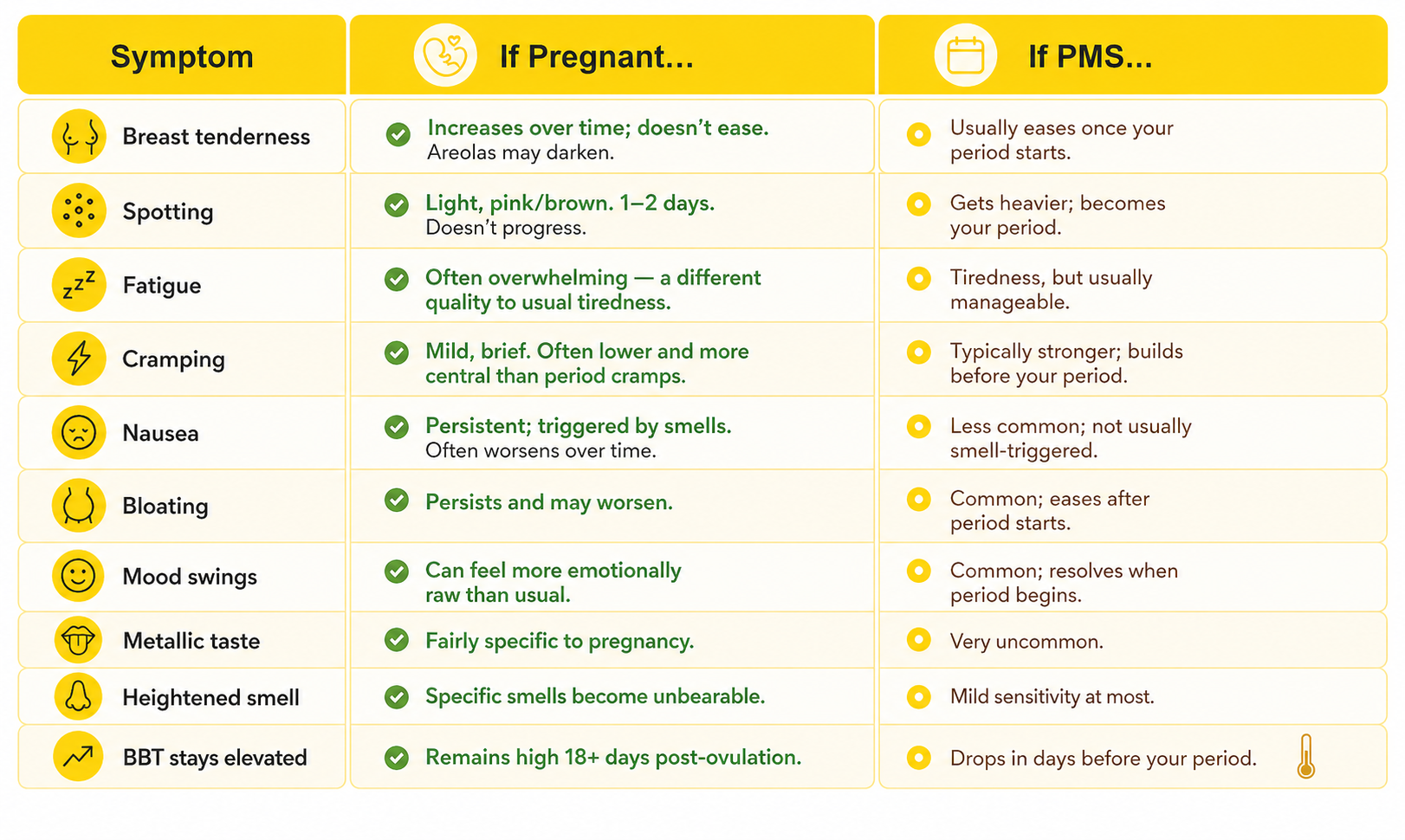
Pregnant or Premenstrual Syndrome (PMS)?
You're probably asking “if you are pregnant how do you know?” Many women usually find early pregnancy symptoms difficult to tell because they're usually similar to symptoms of Premenstrual Syndrome (PMS). Here's how you can tell the difference.
How Symptoms Can Differ in Your 30s and 40s
If you're a woman in her 30s or 40s, your symptoms of pregnancy might be slightly different, yet normal. This is usually because your hormone levels might be slightly reduced compared to a woman in her 20s.
Your cycle may already be more variable
In your mid-to-late 30s, cycle length can start to fluctuate. This makes a "missed period" a slightly less reliable first indicator. You'll need to track your cycle well.
PMS symptoms can be stronger in your late 30s
As you approach menopause, your oestrogen levels begin to fluctuate and PMS symptoms can become more intense. This means the overlap between PMS and early pregnancy symptoms can feel more confusing than it did in your 20s.
When and How to Test
So you've been tracking your cycle, you've noticed a few of the symptoms above, and now you're wondering: how do you know if you are pregnant for certain? The answer is a pregnancy test, but how and when you take it makes a significant difference to its accuracy.
How pregnancy tests work
Both home pregnancy tests and blood tests detect hCG (human chorionic gonadotropin) levels in your samples. hCG is produced by the developing placenta after the fertilised egg implants. Its level steadily increases until it reaches a threshold before it can be detected in a pregnancy test.
The best time to test is the first day of your missed period, or ideally one week after. For most women with a regular cycle, this is around 14 days post-ovulation.
When using a home pregnancy test, use your first morning urine. This is when your urine is most concentrated and hCG levels are highest. To get the best result, choose a sensitive test. Clearblue and First Response Early Result are among the most sensitive available in the UK, and if you get a second line, even if faint, it indicates hCG is present. You can test again in 48 hours to confirm.
Got a negative but still feel pregnant?
Don’t panic. If your period still hasn't arrived 3–5 days later, test again. Early testing can produce false negatives. Also, your GP can order a blood test that detects hCG as early as 7–10 days post-ovulation.
What If You Have No Symptoms at All?
Symptoms of pregnancy are controlled by hormone levels, and those levels are not the same for all women and even between pregnancies in the same woman. It's normal to not have pregnancy symptoms
That said, if you had significant symptoms that suddenly and completely disappear before 12 weeks, talk to your midwife or GP.
Symptoms That Need Immediate Attention
Most early pregnancy symptoms are normal. But there are certain symptoms that always need urgent medical attention. Please contact your GP, midwife, or go to A&E immediately if you experience any of the following:
Heavy bleeding: A much heavier than a normal period, or any bleeding with clots after a positive test
Severe, one-sided abdominal pain: This can be a sign of an ectopic pregnancy.
Shoulder tip pain combined with abdominal pain: another potential sign of ectopic pregnancy
Dizziness or fainting along with pain or bleeding
Extreme vomiting: If you cannot keep any food or water down, you may have hyperemesis gravidarum and need medical support
High temperature combined with abdominal pain: This may indicate infection
If anything feels wrong, please don't wait.
FAQ
Can you feel pregnant before a missed period?
Yes, some women do. Implantation bleeding, mild cramping, unusual fatigue, and heightened smell sensitivity can all appear before a missed period. However, many of these symptoms are shared with PMS, so feeling them doesn't necessarily mean you're pregnant. The only way you can confirm is a sensitive early pregnancy test (from around day 10–12 after ovulation) or a blood hCG test from your GP.
How soon after conception do symptoms start?
The earliest possible symptoms; mild fatigue, implantation spotting, can begin 6–12 days after conception. For most women, noticeable symptoms begin around weeks 4–6, roughly when the period is missed. A small number of women also report feeling different almost immediately. There's no fixed rule.
I took a test and it was negative, but I still think I might be pregnant. What should I do?
Wait 3–5 days and test again, preferably with first morning urine. If you tested before your missed period, hCG levels may simply not have been high enough to detect. If your period still hasn't arrived and a second test is negative, see your GP, a blood test can detect pregnancy earlier than a urine test, and a missed period should always be investigated.
Is morning sickness only in the morning?
No. Pregnancy-related nausea can strike at any time of day or night. Many women actually find it worse in the evening, or throughout the day. It's triggered by hCG and oestrogen levels, not by morning specifically.
Can stress cause pregnancy symptoms without being pregnant?
Yes, to some extent. Significant stress can delay your period, cause breast tenderness, trigger fatigue, and even cause nausea, all symptoms that overlap with early pregnancy. This is why symptoms alone are never a reliable confirmation. If you're trying to conceive and experiencing these symptoms, the most straightforward thing to do is take a test.
What are the very first signs of getting pregnant?
The very earliest signs, before a missed period, are typically implantation bleeding (light spotting), a sustained increase in your BBT (if you track it), mild fatigue, and occasionally a strange metallic taste. These tend to appear 1–2 weeks after conception. For most women, the first clear signal remains a missed period, followed by a positive pregnancy test.
Still Not Sure? Let's Talk
At Fertility Bandwidth, we're here to give you clarity, whether you're in the two-week wait, just got a positive test, or navigating something more complex.
Ready to take the next step?
Start with our Fertility Reset Programmes.
Karen Botha
Karen Botha is a Root Cause Fertility Practitioner who helps couples find the hidden health issues that may be affecting conception, and also guides pregnant couples through their pregnancy journeys. She combines Western science with Eastern wisdom to help couples improve fertility naturally and turns happy couples into families.
