
IVF Triggers: Smarter Individualisation Strategies
Fertility, IVF Treatment, Personalised Care
IVF Triggers: It’s Not Just About Smaller Follicles, It’s About Smarter Individualisation
When a cycle ends in disappointment, many patients are told the next time they will “trigger earlier.” But the real treatment question is not simply whether to trigger at a smaller follicle size. It is whether her entire LH suppression, monitoring and trigger strategy has been properly individualised using everything we already know from her previous cycles.
Looking for the basics of the IVF trigger injection? Read: IVF Trigger Shot Before Egg Retrieval — Timing, Types & What Happens Next →
Reframing the Question: More Than “Triggering Smaller”
After a poor egg collection or unexpected ovulation, it can sound reassuring when a clinic says, “Next time we’ll trigger sooner.” On the surface, this suggests a simple fix: if follicles were “too big” or ovulation happened early, then pulling the trigger at a smaller size should solve it.
If you're approaching egg collection now, read: Preparing for Egg Retrieval — What Actually Matters Before IVF Egg Collection →
But follicle size at trigger is only one piece of a complex chain of events. A patient might have:
Subtle LH rises that were missed between monitoring visits
An unusually rapid response to stimulation late in the cycle
A pattern of premature luteinisation despite “normal” scan findings
Simply moving the trigger a day or two earlier may not address why her body behaved that way in the first place. The more meaningful question becomes: what does her previous cycle-level evidence tell us about how she, specifically, regulates LH, responds to suppression, and progresses toward ovulation?
Using Prior Cycle-Level Evidence as a Personal Blueprint
Every completed cycle leaves behind a trail of data: scan reports, LH and progesterone levels, stimulation doses, follicle growth curves, and the timing of ovulation or trigger.
If a previous IVF cycle didn't go as expected, start by working out what it actually showed before deciding what needs to change. Read: Failed IVF — What Should You Do Before Trying Again? →
Taken together, this is her cycle-level evidence – a personalised map of how her ovaries and pituitary actually behaved under stimulation, not how they were expected to behave on a standard protocol.
💡 Key Idea: The goal is not to fit her into the protocol, but to let the protocol adapt to what her previous cycles have already revealed about her LH dynamics and follicle development.
Individualising LH Suppression: Matching the Method to Her Pattern
LH suppression is often treated as a background detail: agonist or antagonist, start on this day, stop on that day. Yet for some women, the chosen suppression strategy is exactly where things begin to drift off course. Prior cycle data can show whether:
LH began to rise despite antagonist injections, suggesting a need for earlier start, higher dose, or a different suppression method
LH was driven too low for too long, potentially affecting follicle quality and endometrial preparation
She shows a consistent tendency toward premature progesterone rise, indicating earlier or more assertive suppression may be needed
In this context, “fixing” a cycle is not just about a smaller follicle size at trigger; it is about rebuilding the suppression plan around how her LH actually behaved last time.
Rethinking Monitoring: Timing, Frequency and What Gets Measured
Standard monitoring often means scans and bloods every few days. For someone with a history of early LH surges or rapid late growth, that rhythm may simply be too slow. Her prior cycle might reveal that crucial changes happened in a 24–48 hour window that routine appointments never captured.
Individualised monitoring might include:
Earlier introduction of hormone blood tests, rather than relying solely on ultrasound size
Shorter intervals between scans once follicles reach the size at which she previously surged
Targeted LH and progesterone checks around the “danger window” identified from her last cycle
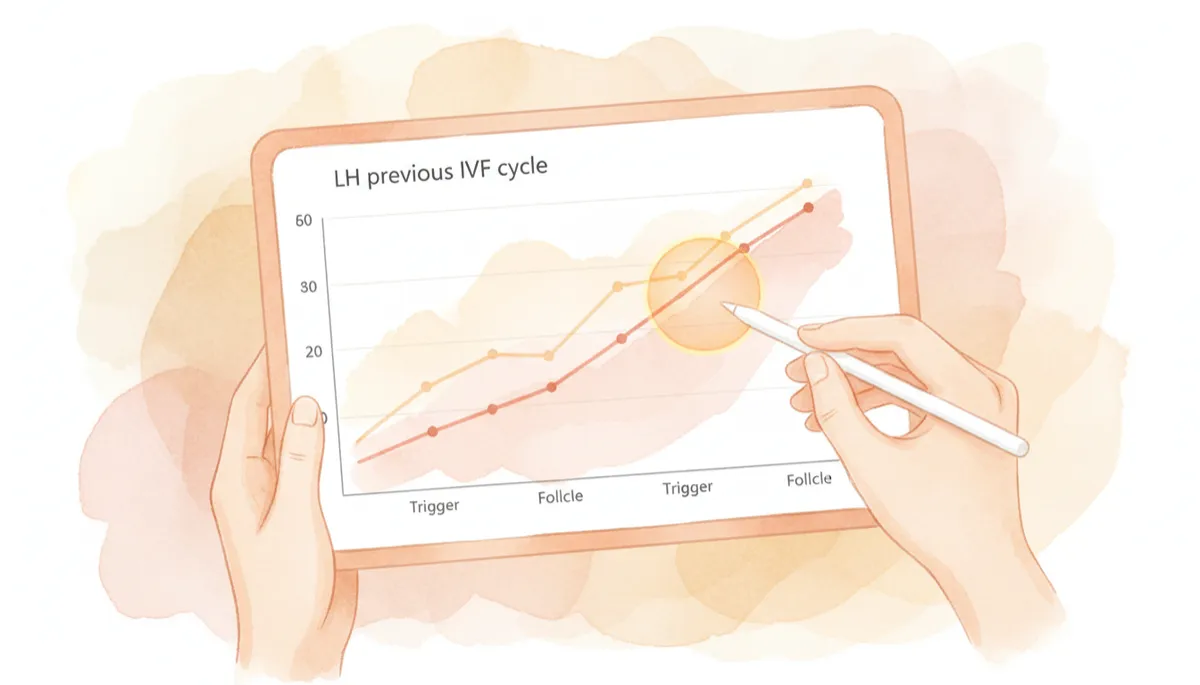
Reviewing prior cycle curves helps pinpoint when monitoring must intensify.
Crafting a Trigger Strategy That Truly Belongs to Her
Once suppression and monitoring are tailored, the trigger itself can be rethought in a more nuanced way than simply “earlier” or “smaller.” A personalised trigger strategy might consider:
Whether a single hCG trigger, a GnRH agonist trigger, or a dual trigger best fits her prior response and risk profile
The follicle size at which she previously showed biochemical signs of approaching ovulation, not just a generic size cut-off
How quickly her follicles grew in the final days, guiding whether a slightly earlier trigger preserves quality without sacrificing maturity
In other words, the treatment question becomes: given what her last cycle already told us about her LH behaviour and follicle dynamics, what combination of suppression, monitoring and trigger timing gives her the best chance this time? The answer is rarely a single adjustment; it is a coordinated redesign.
From One-Size-Fits-All to Evidence-Led Individual Care
Trigger timing is only one part of preparing for IVF. If you're trying to work out what actually deserves your attention before treatment, start with our complete IVF preparation guide.
For patients, this shift in thinking is empowering. Instead of accepting “we’ll trigger earlier” as a catch‑all solution, it invites a more detailed conversation: How will my LH suppression change? How will my monitoring be adapted? What, specifically, are you basing my new trigger plan on from my last cycle?
When clinics treat cycle-level evidence as a personal blueprint rather than a historical footnote, the strategy for LH suppression, monitoring and trigger stops being generic. It becomes a tailored response to her own biology – and that is where meaningful improvements in outcome are most likely to begin.
